WHAT IS ZAFER STYLE ?
A Contemporary Artistic Language created by Pascal Lagesse
The Zafer style is a contemporary artistic universe created by Mauritian artist painter Pascal Lagesse. More than a visual technique, it is a personal language built around colour, geometry, rhythm, repetition, and emotion. Through this style, reality is not simply reproduced ; it is transformed into a more vibrant, hopeful, and emotionally expressive world.
The word “Zafer” comes from Mauritian Creole. It is an undefined word often used to describe “a thing” that cannot easily be named or categorised. This ambiguity perfectly reflects the spirit of the Zafer style itself : a form of art that refuses rigid definitions and exists somewhere between contemporary painting, naïve art, expressionism, symbolism, and dreamlike imagination.



The Origins of the Zafer Style
The Zafer style began to emerge around 2003 through years of experimentation with colour and geometric structures. Before that, Pascal Lagesse had already explored many artistic mediums including oil painting, acrylic, watercolour, pastel, ink, charcoal, and engraving on copper and zinc plates.
His studies in graphic art played a major role in the development of the style. Graphic composition, structure and visual balance gradually became essential elements of his artistic process.
At first, the Zafer works were small paintings on paper and cardboard created with watercolour and poster paint. Over time, the style evolved toward larger canvases using acrylic paint, allowing more complex compositions and stronger colour intensity.

First Zafer painting from 2003
A World Built Through Colour and Geometry
One of the most recognisable aspects of the Zafer style is the use of bold colours combined with geometric repetition. Spirals, circles, lines, dots, squares, and these patterns structure the paintings and create changes in the colour schemes throughout the composition.
These repetitive forms are not merely decorative. They serve several purposes:
-
creating visual Style
-
guiding the eye through the painting
-
building emotional energy
-
transforming reality into something more poetic and symbolic
For the painter, repetition is meditative. It creates harmony within the chaos of contemporary life.
The colours themselves are intentionally vibrant and emotionally charged. Rather than reproducing reality exactly as it appears, the Zafer style seeks to reinterpret the world through emotion and optimism.

Zafer Fish - 2024
Influences Behind the Zafer Style
The Zafer style draws inspiration from several artistic worlds while remaining deeply personal and unique.
Among the strongest influences are:
-
Vincent van Gogh
-
Friedensreich Hundertwasser
-
Australian Aboriginal art traditions
-
Mauritian landscapes and culture
From Van Gogh comes the emotional intensity and directional brushstrokes. Pascal Lagesse often describes the Zafer style as partly inspired by a simplification of Van Gogh’s brushstrokes into geometric forms and repeated visual structures.
From Hundertwasser comes a fascination with his use and juxtaposition of colour, architecture, and flowing forms. The artist's mother had a book showing Hundertwasser's paintings and as a child, Pascal Lagesse used to spend hours in front of the colourful art.
Australian Aboriginal art has been an important source of inspiration in the evolution of the Zafer style. I have always been touched by the richness of their visual language — the dots, the layered motifs, the symbolic forms, and the way an entire world can emerge from seemingly simple elements.
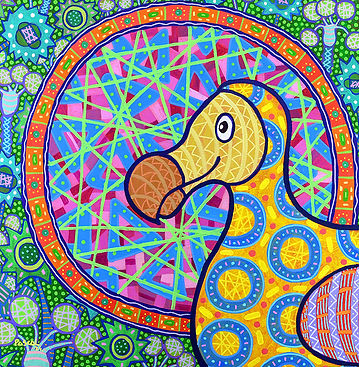
Mauritius itself also plays a central role in the work. Tropical vegetation, lagoons, mountains, dodo bird, architecture, and local cultural identity are frequently transformed through the visual language of the Zafer style.
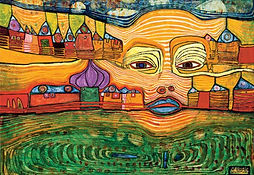
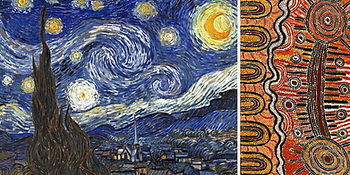
Hundertwasser, Van Gogh and Aboriginal Art

Mauritian dodo
The Philosophy Behind the Zafer Style
The Zafer style was not born from theory or from a desire to follow a particular artistic movement. It emerged gradually from a personal need to cope with inner instability and emotional extremes. Mental illness has played an important role in the very existence of the style. For Pascal Lagesse, painting became a way of reorganising emotions that often felt chaotic, heavy or difficult to control.
Through colours, geometric forms and repetition, he progressively created a visual universe that felt calmer, brighter and more balanced than the emotional states that sometimes surrounded him. The paintings do not attempt to deny darkness or suffering, but rather to transform them into something more hopeful and alive.
In a world increasingly dominated by anxiety, conflict and negative imagery, the Zafer style proposes another possibility: spaces filled with colour, nature, light and emotional openness. Through his work, Pascal Lagesse seeks to create paintings that offer comfort, energy and a sense of hope.
For him, art is not simply decorative. It is a way of transforming perception, emotion and the way people experience the world around them.

Cuddling under the jackfruit tree - 2025
Mauritius Through the Zafer Style
Mauritius is at the heart of many Zafer paintings.
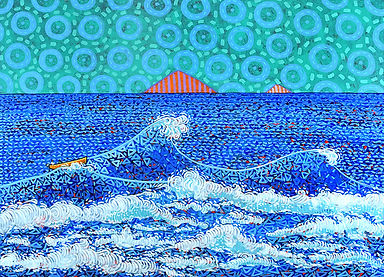
Places such as Le Morne, Coin de Mire or the Pieter-Both mountain often reappear in the work, alongside tropical vegetation, pirogues and the dodo bird. But these places are not painted exactly as they exist in reality. They are transformed into more emotional and dreamlike versions of themselves. Pascal Lagesse humorously says that the landscapes have been "zaferized" !
Over time, his way of reinventing places naturally led to the creation of the verb “Zaferize”. The term is used to describe the act of transforming a place, a subject or even an idea through the visual language of the Zafer style.
Pascal Lagesse often paints the dodo bird which has been extinct since the 17th century and who was endemic to the island of Mauritius. In his depiction of the dodo, Lagesse creates a world that has not yet been touched by humans, a world still spared from the destructive habits of mankind.
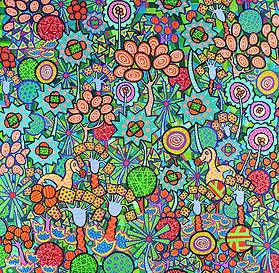
Dodos in the jungle - 2024

On tortoise back - 2024
A Constantly Evolving Style
The Zafer style has never remained fixed. It has changed naturally over the years through experimentation, personal experiences and the desire to keep exploring new directions. The compositions gradually became more detailed and the geometric forms more precise.
This evolution has led to many different explorations, including larger canvases, black-and-white versions, digital painting on iPad, projection work for theatre productions, and more contemporary subjects such as imagined “Zaferized” cities.
At the beginning Pascal Lagesse used to paint on white canvas and after 2022 he switched to red background canvas. As from 2025, he has been experimenting with graphic elements in the background giving depth to the final artwork.
Even though the style continues to evolve, the intention behind it has remained the same from the beginning: to use painting as a way of transforming reality into something more luminous, emotionally alive and hopeful.
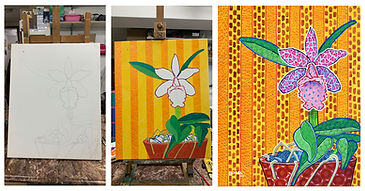
Painting on white canvas - before 2022
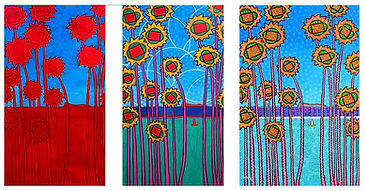
Painting on Red canvas - After 2022
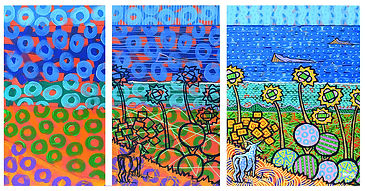
Painting on graphically textured canvas - After 2025
Beyond Categories
The Zafer style does not fit comfortably into a single category. It borrows elements from contemporary art, naïve art, expressionism, graphic art and symbolic painting, while remaining deeply personal in its approach.
Over the years, many people have tried to define it in different ways, but the style was never created to belong to a movement or follow artistic rules. It developed naturally through experimentation, emotion and the need to build a visual world of its own.
In many ways, this is why the word “Zafer” feels so appropriate. As said before, in Mauritian Creole, the word can describe something undefined or difficult to name. The style itself carries that same idea: something hard to classify, yet immediately recognisable once you enter its universe.