
Talent Is Not Enough: Why Consistency Defines the Artist

May 9
3 min read

There is a romantic idea that talent alone is what makes an artist. That some people are simply “gifted,” and that this gift naturally leads to meaningful, lasting work. It is a comforting belief but it is also misleading. Talent may open a door, but it is consistency that allows an artist to walk through it, again and again, over a lifetime.
The reality is simple: without consistency, talent fades into intention. Ideas remain unfinished. Styles remain undeveloped. And potential remains unrealised.
As Pablo Picasso once said: “Inspiration exists, but it has to find you working.” This quote reveals something essential. The act of showing up, regularly and faithfully is what transforms creativity into something tangible. Inspiration is not a magical moment that appears out of nowhere; it is something that grows through practice, repetition, and discipline.
Consistency is not glamorous. It does not always produce masterpieces. In fact, much of it involves doubt, hesitation, and even frustration. There are days when the canvas feels resistant, when ideas seem distant, when nothing flows naturally. But these moments are not failures, they are part of the process. They are the invisible foundation beneath every finished work.
Another powerful reminder comes from the American painter and photographer Chuck Close, who said: “Inspiration is for amateurs. The rest of us just show up and get to work.” It may sound blunt, but it carries a deep truth. Professional artists are not defined by how they feel on a given day, but by their commitment to continue regardless of how they feel.
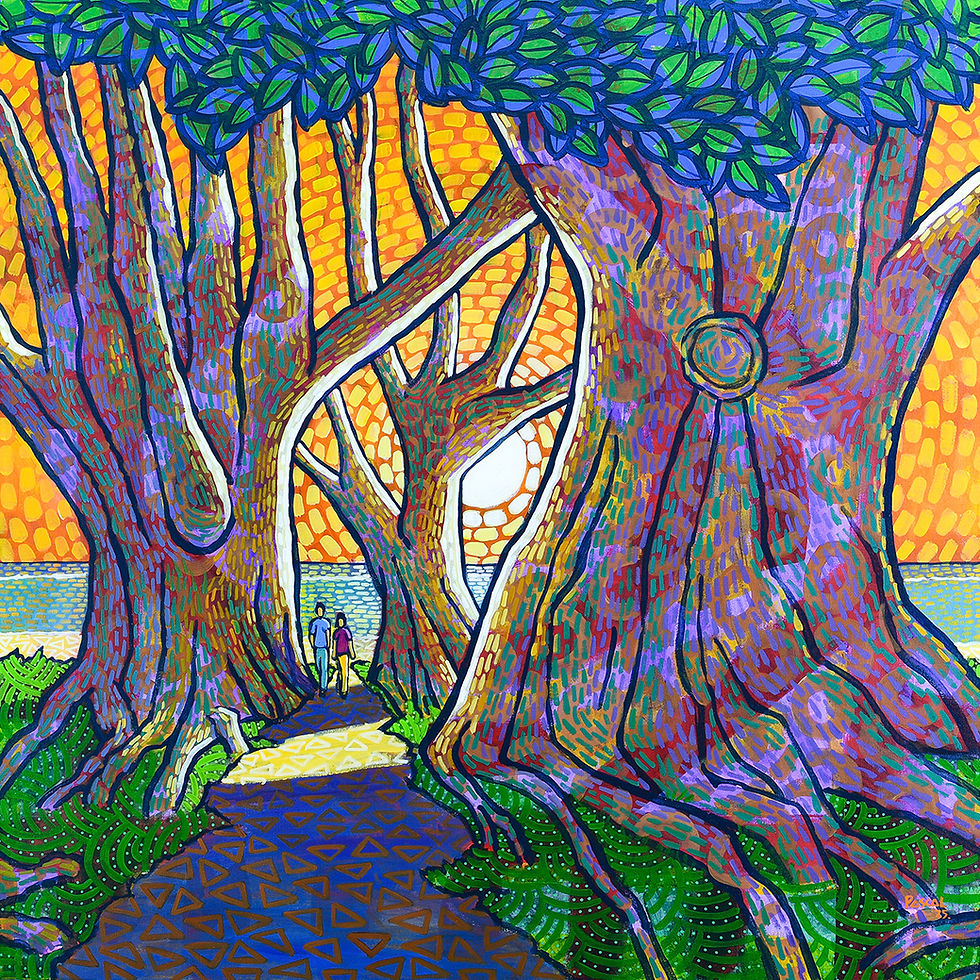
This idea is particularly meaningful when I reflect on my own artistic journey. Developing the Zafer style was not the result of a single moment of inspiration. It was built slowly, over years of exploration, repetition, and refinement. Circles, spirals, geometric structures, bold colours—these elements did not appear fully formed. They emerged through consistent practice, through the willingness to return to the canvas again and again, even when the outcome was uncertain. Talent is not enough.
Consistency also plays a crucial role in staying true to oneself. In a world where trends shift constantly and the art market subtly suggests what “works,” it can be tempting to adapt, to change direction in search of recognition or sales. But consistency acts as an anchor. It allows an artist to deepen their own visual language instead of abandoning it too quickly.
In my work, this means continuing to explore the same core intention: transforming reality into something more hopeful. The repetition of shapes, the rhythm of patterns, the vibrancy of colour—these are not just aesthetic choices. They are part of a language I have built over time. And like any language, it becomes clearer, stronger, and more expressive through consistent use.
There is also a personal dimension to this. Living with challenges such as bipolar disorder means that consistency is not always easy. Some days, the act of creating feels natural and fluid. Other days, it requires effort, discipline, and patience. But this is precisely where consistency becomes powerful—not as perfection, but as persistence. Even small steps forward matter. Even returning to the work, despite difficulty, becomes an act of commitment.

Over time, this commitment accumulates. A body of work begins to take shape. A voice becomes recognisable. What once felt uncertain becomes intentional.
Talent may be the spark, but consistency is the flame that keeps it alive.
To be an artist is not just to create occasionally when inspiration strikes. It is to engage in a continuous dialogue with your work. It is to accept repetition, to embrace imperfection, and to trust that meaning emerges over time.
Because in the end, it is not the intensity of a single moment that defines an artist—it is the quiet, persistent act of returning to the canvas, again and again.


Comments