
Why I Keep Painting the Dodo

May 15
4 min read

There is a creature that has lived in my studio for over twenty years. It has never made a sound. It has waddled across rivers, hidden in jungles, stood at the foot of mountains, and crossed a river in the manner of four famous musicians on a London street. It has nested, wandered, raised its young, and gone about its life with the unhurried confidence of something that has never been told it should not exist.
The dodo, of course, has been extinct for more than three hundred years.
And yet, in my paintings, it is the most alive thing I know.
A creature that gives me joy
I want to be honest about something that artists do not always say aloud: some subjects are painted because they are interesting, and some are painted because they are necessary. The dodo, for me, is necessary.
When times are difficult, painting a dodo is one of the things that brings me back to myself. There is something about this creature, with its round body and its improbable beak and its complete lack of self-consciousness, that produces in me a feeling I can only describe as tenderness. Not sadness. Not guilt, though there is perhaps guilt buried somewhere underneath and that has been following the human kind and his destructive nature for centuries.
I am aware that this sounds like an unusual thing to say about an extinct bird. But I suspect that anyone who has grown up in Mauritius understands it immediately. The dodo is not simply a species that disappeared. It is us. It is our island. It is the thing we carry with us wherever we go in the world, the creature on our coat of arms, the symbol we reach for when we want to say: this place is unlike anywhere else on Earth, and what happened here matters.
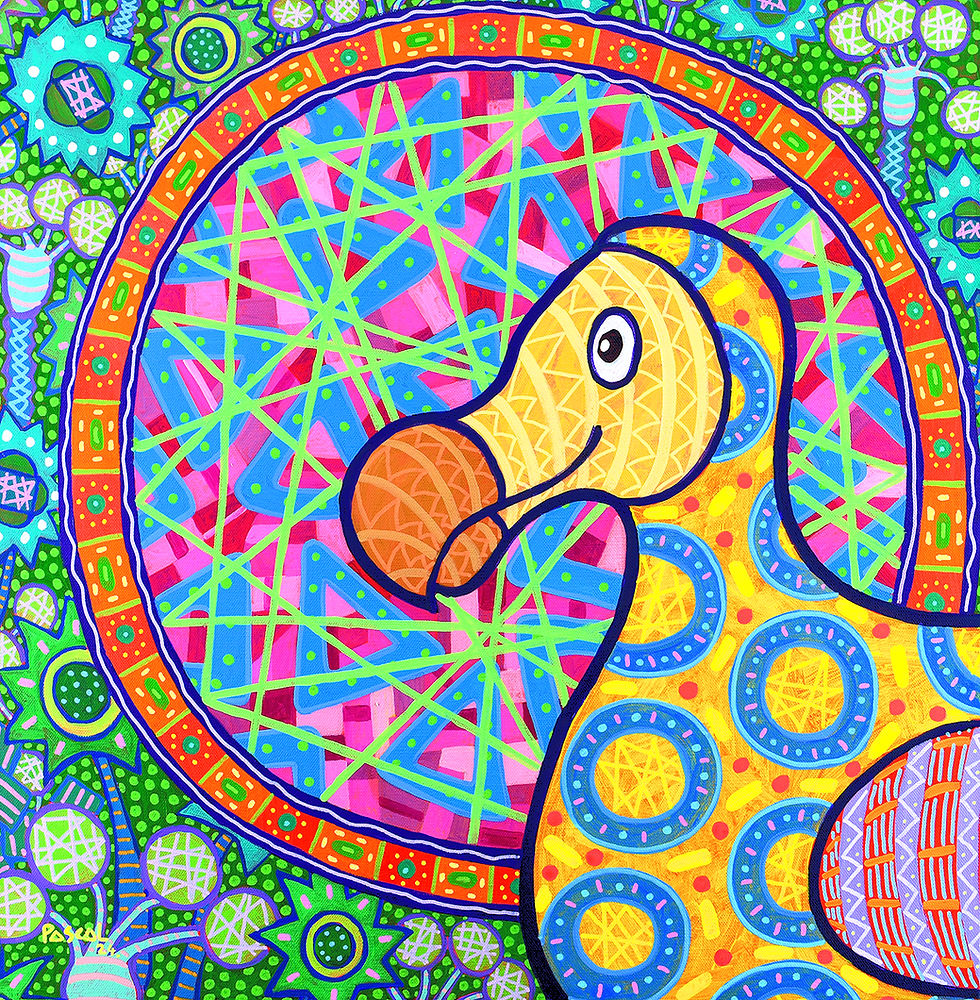
A world before us
Here is the thing that most people do not immediately notice about my dodo paintings: there are no humans in them.
Not one. Not a herdsman in the distance, not a figure on a road, not a fisherman on a boat. In every other landscape I paint, I place small human figures such as the herdsman at Le Morne, the parent walking with a child along the Tamarin road, the fishermen on their pirogues. I include them because I believe in the relationship between people and the places they inhabit.
But in the dodo paintings, I go back further. Before the Dutch ships arrived in Mauritius. Before the first footstep on the beach. Before the rats and the pigs and the cats and the dogs that came with us and did what invasive species do. I go back to the island as it was; untouched, unhurried, extraordinary and I place the dodo there, in the world it actually belonged to.
The vegetation in those paintings is not decorative. It is intentional. The trees are dense and patterned and alive. The forests pulse with colour. The rivers run clean and blue. The mountains stand as they have always stood, long before we gave them names. This is Mauritius before Mauritius was a story about us. It is Mauritius as a story about itself.
I find this image profoundly soothing. I return to it again and again, not because I am nostalgic but because it reminds me that beauty existed before we arrived, and that beauty is therefore not dependent on us. It does not need our permission. It does not need our presence.
That is, in dark moments, a comforting thought.

Hope painted in colour
People sometimes ask me why my paintings are so joyful when the world they depict (an extinct bird, a lost paradise) could so easily be mournful. It is a fair question. The honest answer is that joy is not the opposite of grief. It is what you do with grief when you refuse to be consumed by it.
I am painting a world that no longer exists. I know that. Every time I pick up a brush and begin a dodo painting, I am aware that I am inventing something, not recording it. The Mauritius of my dodo series is not history. It is imagination. It is a question asked in colour: what if?
What if the dodo had never disappeared? What if the forests had never been cleared? What if the lagoons were still as they were, the endemic birds still singing in trees that still exist? What if we had arrived differently ? More carefully, more humbly, more aware of what we were stepping into.
I cannot answer those questions. Nobody can. But I can paint the world those questions describe, and I can make it as beautiful as I possibly know how to make it. I can fill it with colour and pattern and life. I can give the dodo its life back, one painting at a time.
This is what the Zafer style is for, in the end. Not just to be decorative. Not just to be joyful, though it is that too. It is to insist, in the face of everything we know about extinction and loss and the damage we do without thinking, that beauty is still possible. That a world of colour and abundance and creatures going about their extraordinary ordinary lives is not a fantasy. It is a memory. And if it is a memory, it can perhaps also be a direction.

The dodo walks on
In Dodo and Orchid, a single dodo bends gently toward a small white flower. At its feet, a nest of eggs. Behind it, the forest of a Mauritius that never knew us.
I painted it on a difficult day. I painted it slowly, and with great care, and by the time it was finished I felt, not happy exactly, but something close to it. Something steadier. The dodo lives in the Zafer world. This is why I Keep Painting the Dodo.
Life insists. Even in paint. Especially in paint.


Comments