
Peace in Repetition: What Zentangle Teaches Me About My Own Painting

Aug 15
6 min read

When people watch my paintings, they often ask the same question. How do you have the patience to fill a whole canvas with so many small shapes, one after another, for hours at a time? Maybe they expect me to talk about discipline? The truth is closer to the opposite. I am not enduring those hours. I am resting in them. The repetition of patterns and shapes is where I feel most calm, most present, most myself.
For a long time I assumed this was simply my temperament. Then I began reading about a small drawing practice called Zentangle and the growing body of research around it, and I realised that the calm I feel at the easel has a name, a mechanism, and a body of evidence to back it up. I want to share some of that research here, because it says something beautiful about why art like mine can soothe both the person making it and the person standing in front of it. So let's talk about the peace I find in repetition and what Zentangle teaches me about my own painting style.
What Zentangle actually is
Zentangle is a drawing method developed in the early 2000s by Rick Roberts and Maria Thomas. The idea is simple. You take a small square tile of paper and fill it with structured patterns, called tangles, built from basic repeated strokes: lines, dots, curves, circles. There is no grand plan and no subject to capture. You are not trying to render a landscape or a face. You simply repeat one small pattern until it feels complete, then move to the next.
Two principles sit at the heart of it. The first is that there are no mistakes. Every stroke is ok, and anything unexpected becomes part of the design rather than a failure. The second is that the point is the process, not the finished picture. You draw to be in the drawing, not to arrive somewhere.
Even reading that description, I felt a flicker of recognition. It is not exactly how I paint since my paintings depict a scenery, but it is very close to how painting feels to me.
What the research shows
What surprised me was how much this practice has been studied, and how consistent the findings are.
A pilot randomised controlled trial published in the American Journal of Occupational Therapy (2022) set out to test whether Zentangle, described by the researchers as having repetitive, mindful and meditative qualities, could improve emotional wellbeing in ordinary adults. The 38 adults from the general public who took part in a guided session and kept practising afterwards reported reduced anxiety and improved self-compassion.
Four researchers from Ming Chi University of Technology in Taiwan went looking inside the brain. In one study, adults with no previous experience were asked to try Zentangle while their brain activity was recorded. Afterwards, they reported feeling calmer and less anxious, and their brainwave patterns shifted toward relaxation, with less activity linked to alertness and more of the slower pace associated with a settled, meditative state. A wider review of the available studies reached a similar conclusion: this kind of structured, repetitive drawing tends to steady the mind.
The effect is not confined to laboratories. One study looked at healthcare workers, people carrying real and heavy stress, and found that a Zentangle workshop helped relieve their psychological distress and eased the pressure they brought home from work. The repetition, again and again, seemed to carry them toward a calmer, more contemplative place.
Zentangle also has a close and better-studied cousin: the mandala. Several controlled studies have found that colouring a structured mandala reduces anxiety more effectively than colouring a free, open shape or simply sitting quietly. The structure itself, it seems, carries part of the healing.
I should be honest about the limits here. Most of these studies are small, and the researchers themselves describe the evidence as promising rather than proven. This is a young field, and I am no scientist. Without the help of AI (Claude), who found these studies online for me, I would never have heard about Zentangle. I am happy that now I can put a name to what I have been experiencing and developing since 2003.
Why repetition calms us
The more interesting question is why. Why should repeating small shapes calm a restless mind?
Part of the answer is much older than Zentangle. Decades ago, the physician Herbert Benson described what he called the relaxation response, a natural physiological state, the opposite of stress, that can be brought on by a simple activity paired with a calm, unforced attitude. Repetition is the key ingredient. When the hand does the same gentle motion over and over, the body seems to read it as a signal of safety, and the nervous system begins to slow.
There is also the matter of decision-making. So much of our daily anxiety comes from constant small choices and the fear of getting them wrong. Repetitive pattern-work gently removes that burden. Each mark follows naturally from the one before. The next step is obvious. The mind, relieved of having to decide and to judge, is finally allowed to rest.
And then there is the action of painting, which can be described as complete absorption in what you are doing, where self-consciousness fades and time seems to disappear. Repetitive shape-making is one of the surest ways into it, because it asks just enough of you to hold your attention without straining. This is the state I lose myself in for hours. I now understand that it is not idleness. It is one of the most restorative things a mind can do.
Where Zentangle and the Zafer style meet
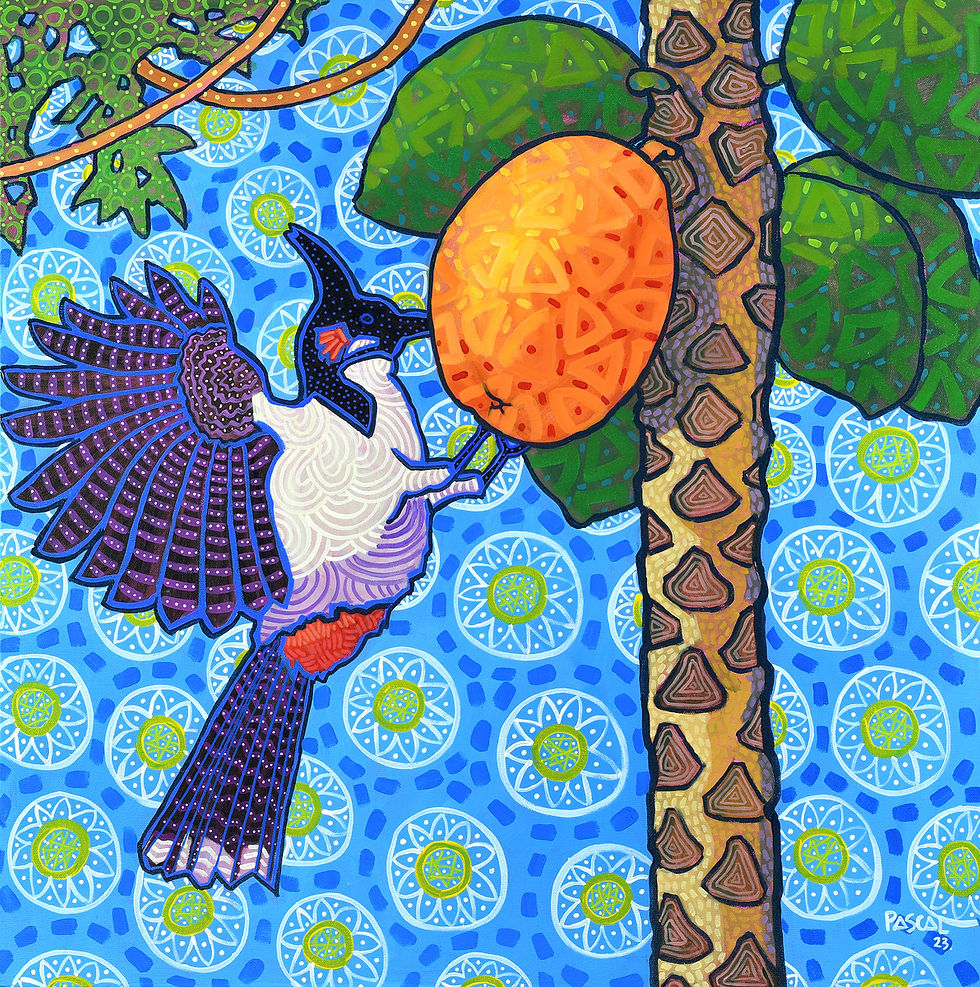
I paint in a style I call Zafer, built from repetitive patterns and shapes: circles, dots, triangles and lines, held together by bold outlines and bright colours. On the surface, many read it as simply decorative, but beneath the surface, my brushstrokes have other personal meanings. I build a whole surface from many small, repeated marks and find calm in the action of that repetition rather than in the rush toward a result. Here, there are no mistakes, only patterns that find their place. I cannot count the times a stroke went somewhere I did not intend, and instead of correcting it, I let it become the underpainting of a new motif.
That idea about structure is the deepest link. Remember the mandala studies, where the structured shape soothed more than the free one. My work is nothing if structured. Every motif sits inside a clear outline, every pattern has its logic and its place. When I fill those spaces, I am giving my own mind exactly the kind of ordered, predictable drawings that the research suggests the human nervous system finds so calming.

Where they part ways
The differences matter too, and I hold them with affection.
Zentangle is deliberately abstract and unplanned. It has no subject, and that is its gift: it frees you from having to represent anything. My painting runs the other way. Beneath all the pattern, there is always a plan, a real place, a feeling of my island that I want to hold on to and give to someone else. Zentangle usually consists of drawings on a small white tile. My work explodes with colour, because colour is where my joy lives.
There is a difference of purpose as well. Zentangle is a wellness practice designed so that anyone with no training at all can pick up a pen and feel better. My paintings are finished works, meant to hang on a wall and speak for years. Yet I have come to believe these two purposes are not so far apart. The well-being the artist pours in does not vanish when the work is done. I think it stays on the surface, and reaches the person who later stands before it. It took me 23 years to find out that what I was doing instinctively had a name.
Painting joy, one shape at a time
I have always said that my aim is to paint joy in a world that needs it. Learning about the research around Zentangle has given me a new way to understand that the joy is also within me. Perhaps some of what a viewer feels in front of one of my canvases; that sense of calm and lightness is the echo of the calm I felt while making it, shape after shape.


Comments